


In compliance with and support of Law No. 14,611, we at PBA STONES reaffirm our commitment to our core values: Integrity, Reliability and Attitude. We work continuously to integrate these principles into our corporate culture and promote them as a standard for all employees.
Learn more: On July 3, 2023, Law No. 14,611 was enacted, addressing equal pay and remuneration criteria for men and women in the workplace and amending Article 461 of Brazil’s Consolidation of Labor Laws (CLT). Companies with more than 100 employees must adopt measures to ensure this equality, including pay transparency, enforcement against discrimination, reporting channels, diversity and inclusion programs, and support for women’s training. The law is an initiative of the Ministry of Labor and Employment and the Ministry of Women.
Source: Ministry of Labor and Employment — Pay Transparency Report adds new information.
English translation of the official report
Reader’s translation of the Portuguese report shown above — First half of 2026. The original image is retained as the official document. Values and categories below are reproduced as displayed in that report.
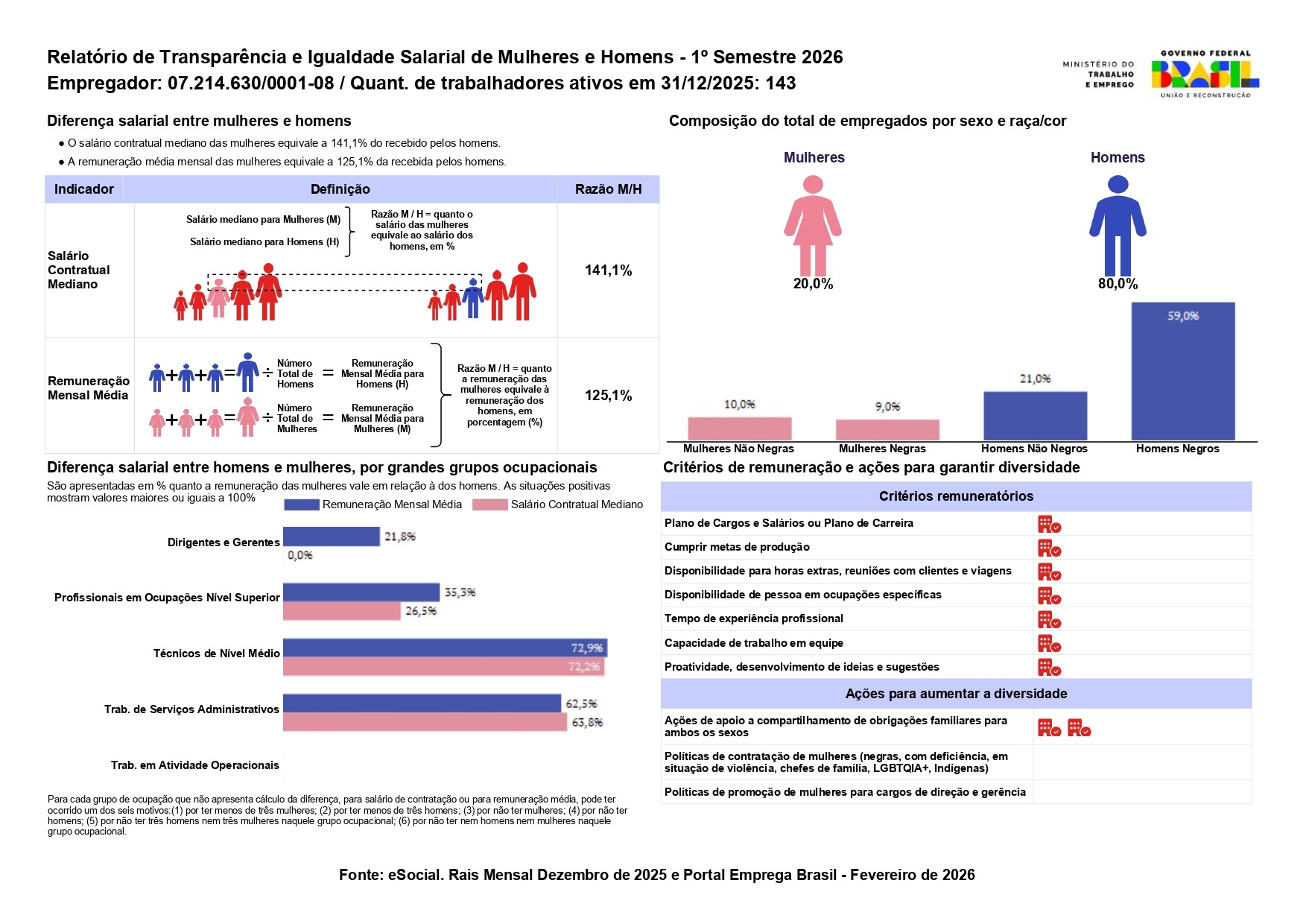
Employer: 07.214.630/0001-08. Active workers on December 31, 2025: 143.
Pay difference between women and men
Women’s pay as a percentage of men’s pay. The median contractual salary ratio compares the median salary for women with the median salary for men. Average monthly remuneration is calculated by dividing total remuneration for each sex by the corresponding number of workers, then comparing women’s average with men’s average.
| Indicator | Women/men ratio |
|---|---|
| Median contractual salary | 141.1% |
| Average monthly remuneration | 125.1% |
Workforce composition by sex and race/color
| Category | Share of employees |
|---|---|
| Women | 20.0% |
| Men | 80.0% |
| Non-Black women | 10.0% |
| Black women | 9.0% |
| Non-Black men | 21.0% |
| Black men | 59.0% |
Pay difference by major occupational group
The percentages show women’s remuneration relative to men’s. The report describes values of 100% or more as positive situations.
| Occupational group | Average monthly remuneration | Median contractual salary |
|---|---|---|
| Directors and managers | 21.8% | 0.0% |
| Professionals in higher-education occupations | 35.3% | 26.5% |
| Mid-level technicians | 72.9% | 72.2% |
| Administrative service workers | 62.5% | 63.8% |
| Operational workers | Not displayed | Not displayed |
When a pay comparison is not calculated for an occupational group, the report lists these possible reasons: fewer than three women; fewer than three men; no women; no men; neither three men nor three women in that occupational group; or no men or women in that occupational group.
Pay criteria and actions to promote diversity
Pay criteria listed: job and salary plan or career plan; meeting production targets; availability for overtime, client meetings and travel; availability of people in specific occupations; length of professional experience; teamwork skills; and initiative, development of ideas and suggestions.
Diversity actions listed: support for sharing family responsibilities between both sexes; policies for hiring women (Black women, women with disabilities, women experiencing violence, heads of household, LGBTQIA+ women and Indigenous women); and policies for promoting women to director and management positions. The original image retains the symbols shown alongside these entries.
Source: eSocial; Monthly RAIS, December 2025; and Portal Emprega Brasil, February 2026.